Audio at publisher scale means thousands of articles narrated every day. At that volume, the honest question isn’t whether a run-time model produces perfect audio — it’s who catches the ones it doesn’t, and how fast.
AI Quality Control is the answer we shipped. A three-stage pipeline runs after every narration — fast checks, ASR re-listen, an audio-model verdict — and every check measures the seams between voice chunks, the acoustic joins where narration breaks. The strongest measurement per article is kept and scored against thresholds set per publisher.
Article
What the dashboard shows
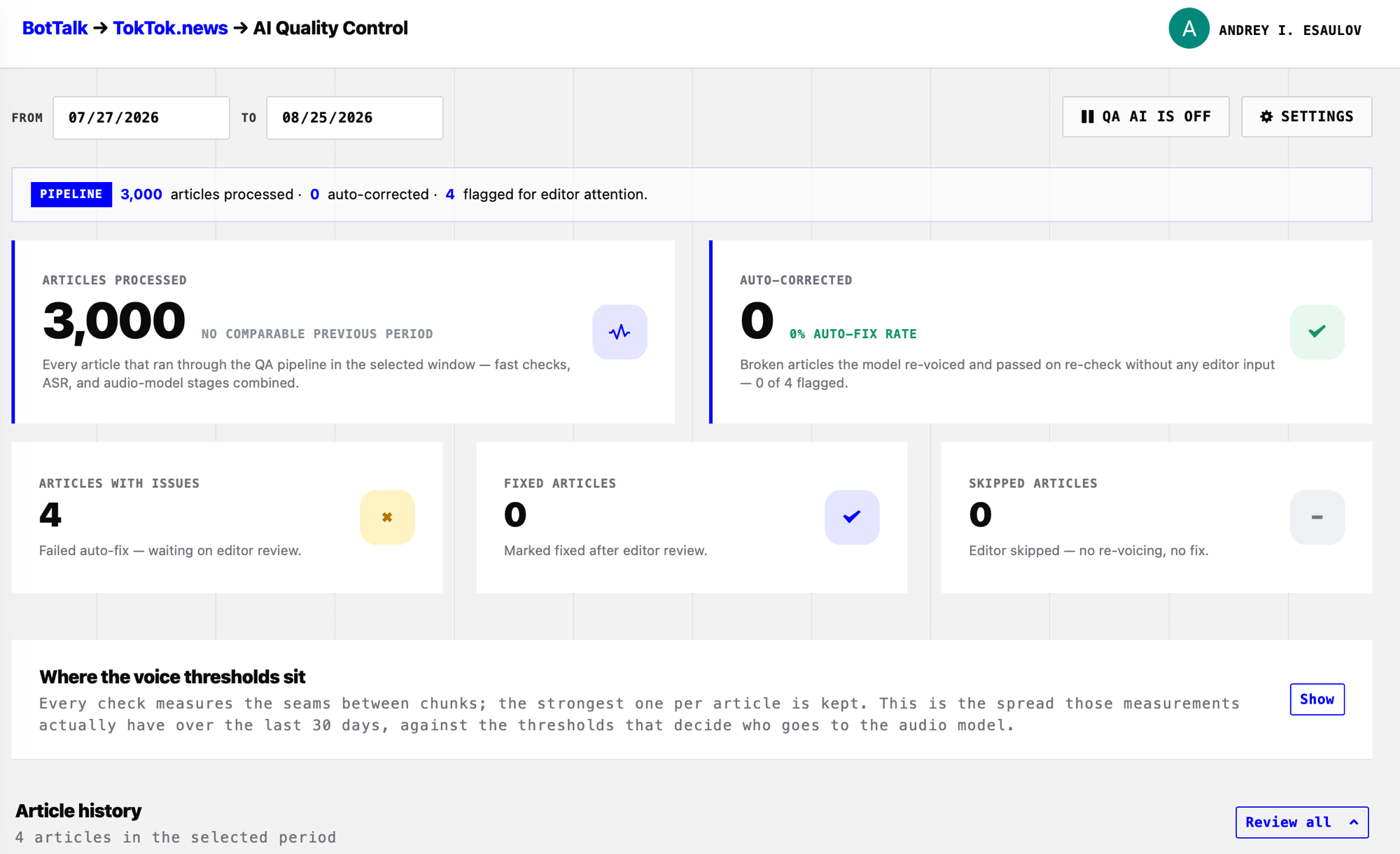
One view per publisher, scoped to a date range. The pipeline counts every article that ran through it, how many the model re-voiced and passed on re-check without any editor input, how many failed auto-fix and are waiting on an editor, how many editors marked fixed, and how many they chose to skip.
The article history
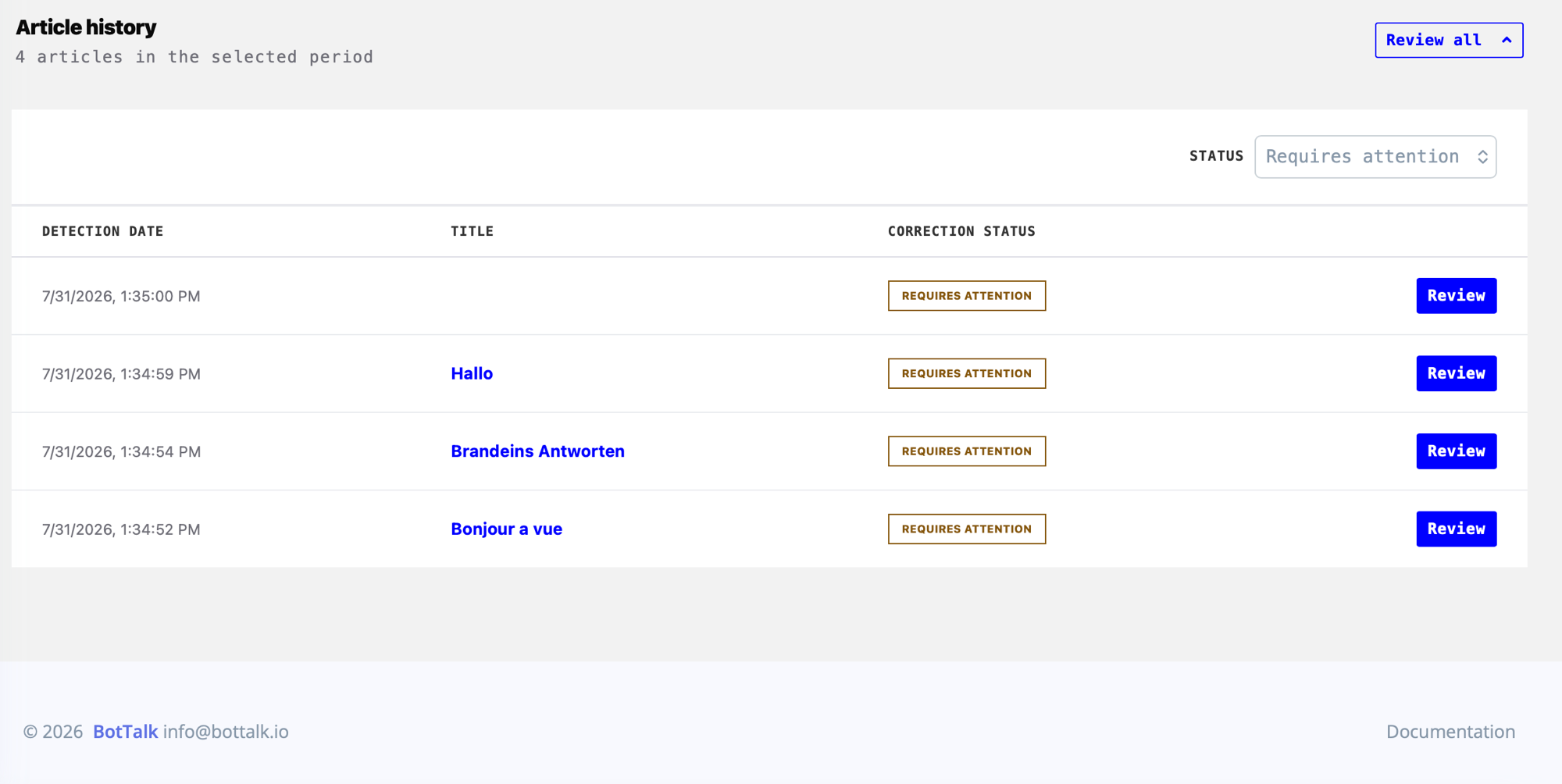
When something is flagged, the editor doesn’t have to hunt. The article history table lists every detection in the window, sorted newest-first, filterable by status. Each row opens a side-by-side review: the passage the model heard, the timestamp of the seam, and the option to re-voice, mark fixed, or skip.
How the model decides what’s broken
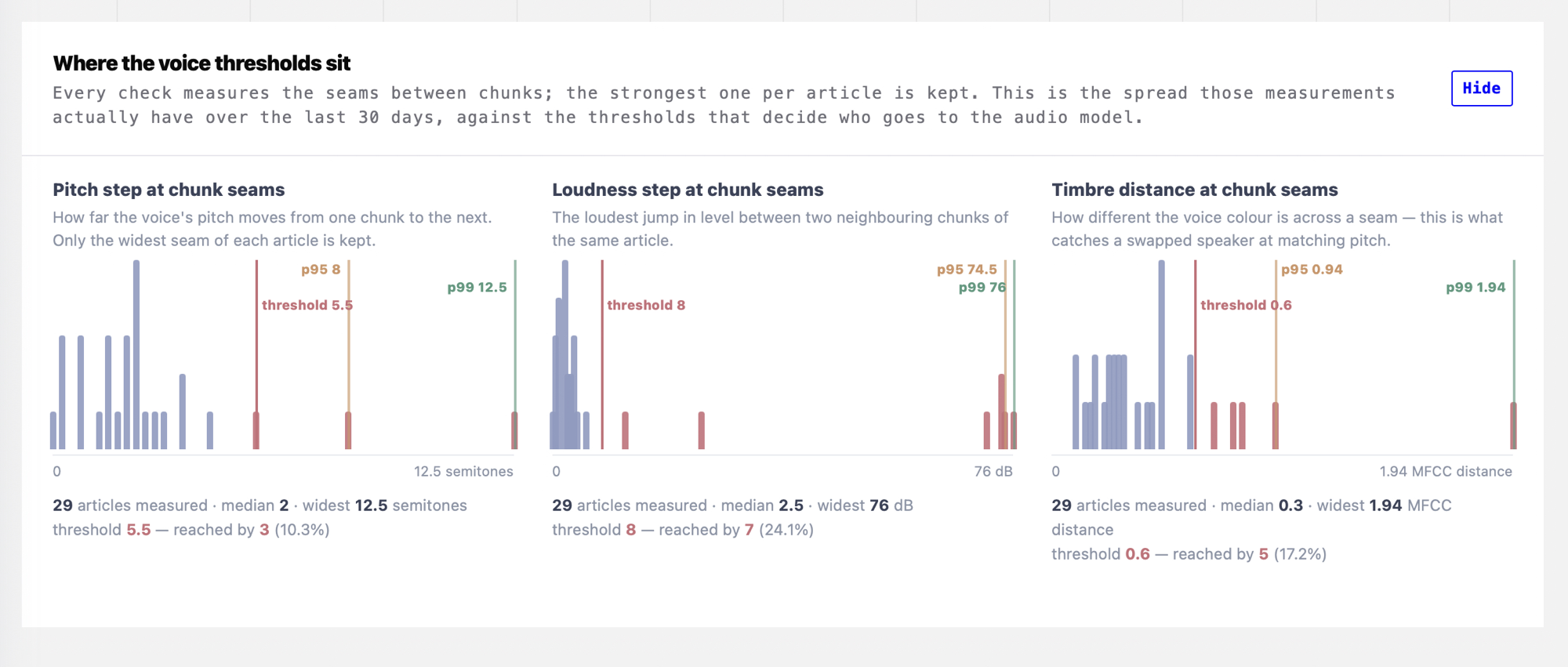
Every check runs three measurements at each chunk seam: the pitch step (how far the voice’s pitch moves from one chunk to the next), the loudness step (the sharpest jump in level between two neighbouring chunks), and the timbre distance (how different the voice colour is across a seam — the check that catches a swapped speaker at matching pitch). The strongest measurement per article is kept and scored against thresholds set per publisher.
Why we shipped it now
Publishers running BotTalk have hit the volume where perfect manual QA on every article is impossible and no-QA-at-all is unacceptable. Editors kept asking the same three questions in standups: how many ran, how many broke, how many did we already fix without me knowing. The dashboard answers all three in the top row.
What’s in the box today
- Three-stage pipeline — fast checks, ASR re-listen, audio-model verdict — running on every narration, per publisher.
- Auto-fix loop for anything the model can re-voice cleanly on re-check. When it lands, the editor is never paged.
- Editor queue for the residue: one filterable table, one-click review, three verbs (re-voice, mark fixed, skip).
- Per-publisher thresholds the editor can tune. Every check measures the seams between chunks; the strongest measurement decides who goes to the audio model.
- Pause switch in the top-right — the editor can freeze the automated pipeline mid-day if they want a manual pass on the next batch.
Where it goes next
Two lines of work already on the ledger for the next few releases: publisher-wide voice thresholds exposed as a settings panel (today an internal knob), and a compact digest email every editor can subscribe to — one number per day, one link into the dashboard, no dashboards to check when nothing broke.