
Liquid Content: The Operating Model That Lets One Article Reach Every Format
The problem with static content
The average article you publish today reaches exactly one type of reader, in exactly one format, on exactly one surface. That is the problem.
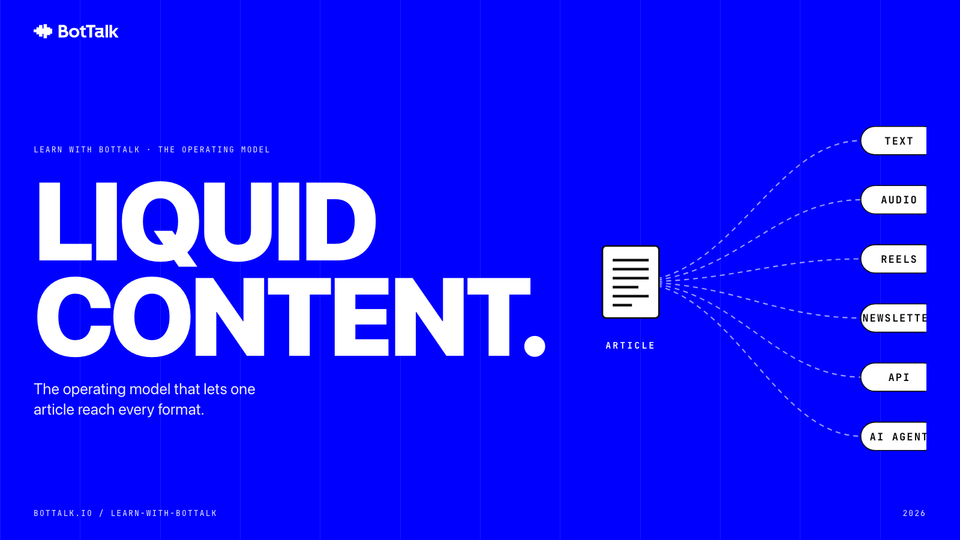
Most publishers treat content like a fixed product — write it, publish it, done. But a growing number of newsrooms are discovering a fundamentally different model: one piece of material becomes a living asset that flows into text, audio, video, newsletters, AI agents, and platform-specific formats without a single manual reprocessing step.
This is what the industry is quietly calling liquid content — and the numbers suggest it is not a trend. It is becoming the new operating standard. As we've explored before, the shift from content as an artifact to content as a flow is already underway in leading newsrooms.
What the data actually says
The scale of the opportunity is documented across multiple research tracks. According to the Reuters Institute Digital News Report 2025, which tracks 90,000 consumers of media across 47 countries, publishers who have automated multi-format content distribution are consistently outperforming peers on audience retention. The report identifies AI-augmented distribution as one of the three structural shifts reshaping the publisher landscape through 2026 and beyond.
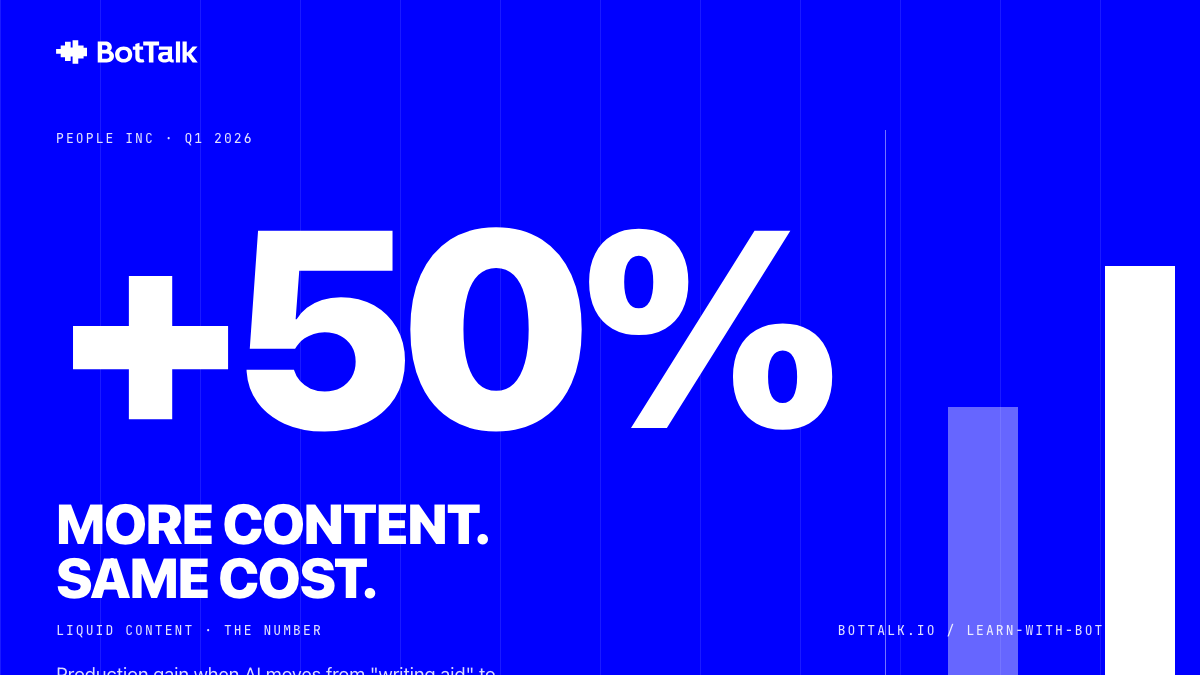
People Inc, the US publisher behind titles like People.com and Essence, quantified the efficiency gain precisely: AI-assisted production enabled the company to create 50% more content at the same cost, and of higher quality than three years earlier. Their non-website income (social, events, AI licensing, Apple News) grew 24% year-on-year in Q1 2026, now representing 41% of total digital revenue ($103m of $253m). The mechanism is consistent across cases: a single investigative piece gets pushed through three outputs simultaneously — the long-form article, a condensed vertical on TikTok, and an explainer audio track. Editorial investment is made once; the reach compounds.
The implications for how publishers think about content operations are significant — as we covered in our analysis of why the publisher product is becoming a flow of formats around one story.
How leading publishers are operationalising it
Deutsche Presse-Agentur (dpa) — Germany's largest wire service, serving approximately 170 media companies — launched dpa-iq, a trusted information layer designed to deliver verified news directly into the AI-powered workflows of client newsrooms. As AI agents increasingly do the work of information-seeking on behalf of users, dpa-iq ensures content flows to those agents without manual intervention — an API-first modular system where the same content object is accessible to multiple downstream formats simultaneously.
United Daily News Group in Taiwan applied a four-tier AI framework (Interpretive, Predictive, Generative, and Agentic AI) to restructure how a single piece of content moves through commercial workflows. Their AI-targeted advertising campaigns delivered click-through rates more than 230% higher than standard placements, across 136 industry categories.
Rappler in the Philippines reorganised its entire newsroom around content-community-technology clusters, where a major investigation automatically generates text, video, photo, and community-submission layers simultaneously. Their #FloodControlPH campaign reached audience sectors that had never engaged with the Rappler brand — the investigation was built from community inputs flowing directly into the same story structure.
The architecture of liquid content
What separates publishers who are making this work from those who are still treating content as a static output is architectural. The liquid content model has three structural layers.
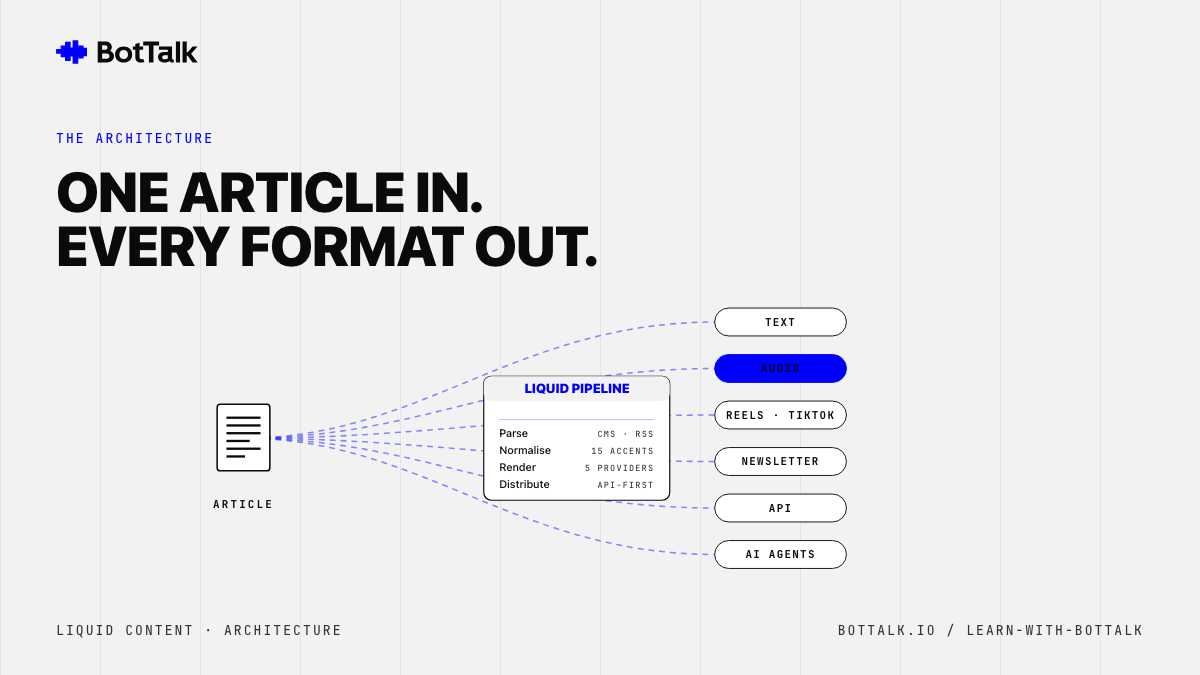
First, content as a modular object, not a page. Rather than publishing an article that exists only as a webpage, the content is structured as a data object with metadata, key assets, and semantic layers that can be queried and rendered in different formats. An article about a central bank interest rate decision, for example, contains the raw copy, the data points, the key quotes, the geographic context, and the historical comparison as separate addressable elements.
Second, automated transformation pipelines. AI systems take the content object and render it for different surfaces — voice for audio, shortened and visually enriched for social, structured as a data table for newsletters, formatted as an API response for AI assistants. This is not manual repurposing; it is programmatic transformation. The contrast with manual content repurposing is stark in terms of speed, consistency, and scalability.
Third, distribution as a service. The same content flows to owned channels, platform channels, and AI agent endpoints simultaneously via API. The publisher no longer decides where to send the content — the content is available everywhere that has access to the API.
The numbers that should make publishers listen
Google search traffic now represents just 25% of core sessions at People Inc, down from 55% in Q1 2024. In two years, Google's share of their audience halved. During the same period, off-platform views across Instagram, TikTok, YouTube, and Apple News grew 62%.
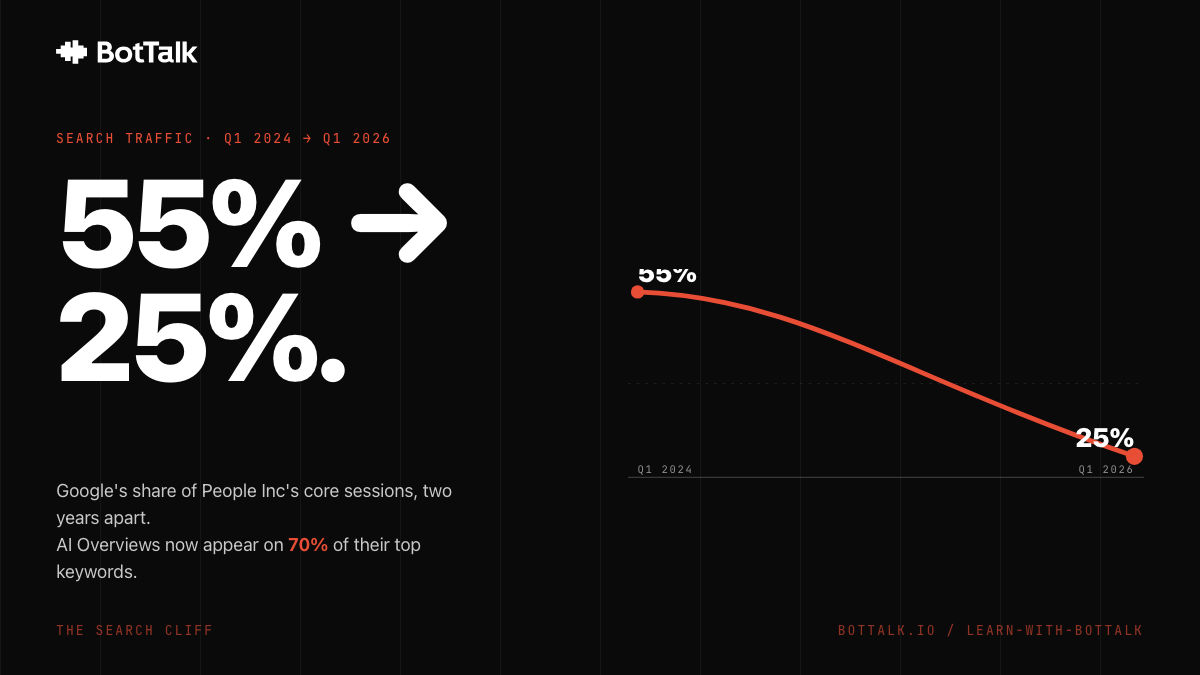
AI Overviews now appear on almost 70% of the 10,000 top People Inc search keywords in Google. When an article is summarised by AI before the user clicks through, the traditional pageview model breaks. Publishers who survive that transition are those whose content is valuable enough to be surfaced by AI agents — and accessible enough to be pulled into agentic workflows automatically.
The Reuters Institute data shows a consistent pattern across European markets: audiences who engage with publisher content through AI-assisted discovery show higher long-term retention than those who arrive via traditional social shares. AI discovery tends to surface content that is genuinely relevant, not viral.
What publishers are actually doing about it
At the 2026 International Journalism Festival in Perugia, the dominant conversation was not about whether to adopt AI — it was about how fast to move. Sessions focused on what was described as the 'agentic web' — a developing environment where AI agents act as intermediaries between content and audiences. Publishers were navigating practical questions about how one story can serve a human reader, a voice assistant, and an AI agent simultaneously.
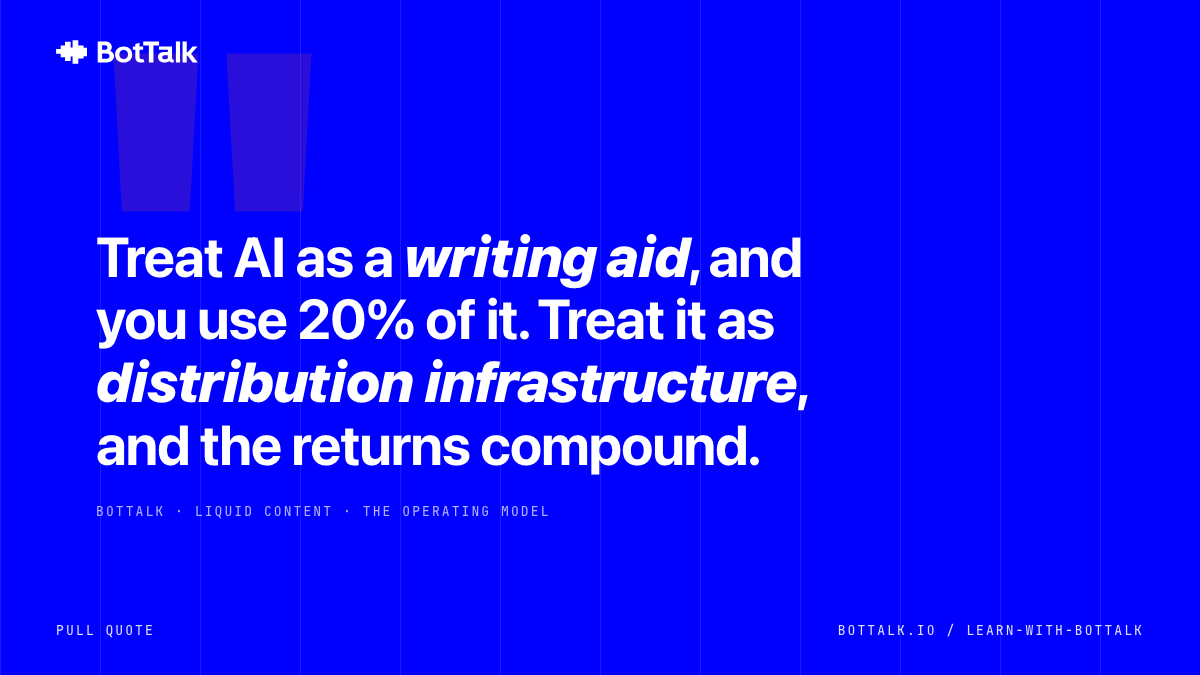
The Reuters Institute's 2026 trends analysis identified the structural shift clearly: AI is moving from a tool that assists production to a layer that mediates distribution. Publishers who treat AI as a writing aid are using it at 20% of its potential. Publishers who treat it as a distribution infrastructure are unlocking compound returns on every piece of content they produce.
The operating model shift
The liquid content model is not a technology upgrade. It is an operating model change. Most publishers still structure their workflow as: research, write, edit, publish, distribute. The liquid content model restructures it as: create once, transform automatically, distribute everywhere.
The practical implication is that the bottleneck in most newsrooms is no longer the writing — it is the transformation and distribution layer. A team that can produce 10 articles per day but only publishes them as text on a website is using a fraction of the content's potential reach. The same team with an AI-powered transformation pipeline can serve those 10 articles as text, audio, social video, newsletter content, and AI-accessible data simultaneously.
The publishers making this transition are not the largest or best-resourced. They are the ones who decided that every piece of content is an infrastructure asset, not a finished product. The ones still treating each article as a one-time delivery are building on sand.
Making audio part of the liquid content model
Voice is one of the most underserved channels in the liquid content stack. Most publishers have text covered, some have video, fewer have properly scaled audio. But audio is uniquely suited to the liquid content model: it reaches audiences during commutes, workouts, and other moments when screens are not an option — and it does so at a fraction of the production cost of video. The publishers already seeing strong audio adoption are often the same ones seeing stronger overall retention, because audio keeps their brand present in moments when other formats simply cannot reach.
BotTalk helps publishers add high-quality audio to their content in minutes — no engineers required. The integration takes less than a day and works with any CMS. If your editorial team is producing content that could be reaching audiences in audio, voice, and AI-agent formats but is currently stuck in a text-only loop, book a demo to see how it works.
Sources
Reuters Institute Digital News Report 2025
WAN-IFRA: How the German Press Agency is reinventing news distribution for the agentic age
WAN-IFRA: How Taiwan's United Daily News Group uses data and AI to reclaim advertising revenue
WAN-IFRA: Rappler shifts away from platform dependence
Press Gazette: People Inc grows digital revenue despite Google traffic collapse